

Table of Contents
- Quick Answer
- Key Takeaways
- What Parts Make Up the Price of a Dental Implant?
- Why Does Bone Grafting Add to the Total?
- Why Does a 3D Scan Appear on the Estimate?
- How Do the Number of Teeth and the Restoration Change the Fee?
- Does Dental Insurance Pay for Implants?
- How Can Financing Spread Out the Cost?
- What Should an Itemized Implant Estimate List?
- Frequently Asked Questions
- Related Reading
An implant total is several smaller fees added together, and a personalized estimate after an exam shows which ones apply.
How much do dental implants cost in Houston, TX? The answer depends on how many teeth are being replaced, whether the jawbone needs preparation first and which crown or denture goes on top. An exam and imaging come first, so the dentist can give a personalized estimate instead of a guess.
An implant is a titanium post placed in the jawbone to replace the root of a missing tooth. It is later topped with a crown, bridge or denture. Each piece, plus the imaging and any preparation, carries its own fee, which is why one estimate can look very different from another.
Quick Answer
Dental implant costs in Houston, TX, depend on the number of teeth replaced, any bone grafting, imaging, sedation and the type of restoration. Every mouth is different, so the dentist gives a personalized estimate after an exam and a 3D scan. An itemized estimate shows what each part costs.
Key Takeaways
- An implant has three parts, and an estimate usually lists the post, connector and crown separately.
- A bone graft rebuilds thin bone before placement, and it adds its own step and fee.
- A 3D scan maps the bone and nerves, so the dentist plans from measurements.
- Insurance may pay part of implant treatment, and financing can cover the balance that remains.
- An itemized estimate lets a patient compare two offices line by line.
What Parts Make Up the Price of a Dental Implant?
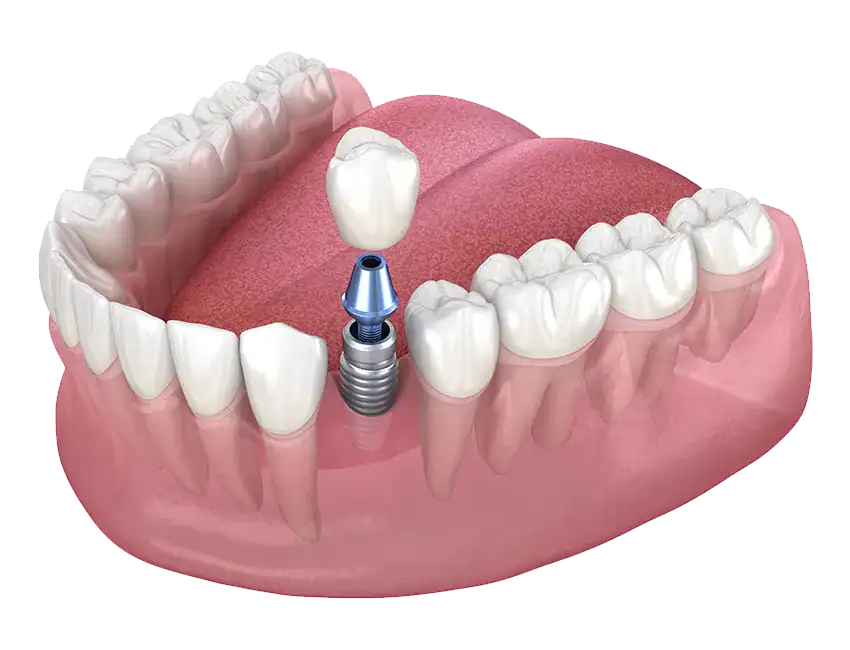
A single-tooth implant has three parts, and an estimate usually lists each one. The post goes into the jawbone, the abutment is the small connector that rises through the gum, and the crown is the visible tooth.
According to MouthHealthy from the American Dental Association, implants are placed in phases. The dentist surgically places the post, the bone around it heals in a process called osseointegration, and then the replacement tooth is attached. Those phases are one reason an implant total covers several steps instead of a single procedure.
Why Does Bone Grafting Add to the Total?
A graft adds a separate procedure and a separate fee, because an implant needs enough healthy bone to hold it. When a tooth has been missing for a long time, the jawbone around the space can shrink, and a graft rebuilds that foundation before the post goes in.
The graft also has its own healing time, which can push back the final crown. Whether a patient needs one depends on how much bone the scan shows, and the dentist makes that call after reviewing the images.
Why Does a 3D Scan Appear on the Estimate?
A 3D scan shows the height and width of the jawbone, the position of nerves and the space between neighboring roots. That lets the dentist plan where the post should sit and at what angle before surgery begins. Planning from measurements helps avoid surprises during the procedure.
The scan also shows whether a graft is likely, which is why imaging often comes before a final price is given. An estimate given before the scan may change once the dentist reviews the images.
How Do the Number of Teeth and the Restoration Change the Fee?
The number of teeth being replaced changes the total directly. A single crown on one post is the simplest case. A bridge that replaces several teeth, or a denture anchored on implants, needs more posts or a larger custom restoration.
Because of that, a price for one tooth cannot be used to guess the cost of replacing several. Sedation is another line on some estimates. Options include nitrous oxide, oral sedation and IV sedation, and the level chosen can add to the total.
Does Dental Insurance Pay for Implants?
Coverage depends on the plan. A dental plan may pay part of implant treatment and may set a yearly maximum that a multi-step procedure can reach.
A plan may treat the extraction, the post and the crown differently, so it helps to compare the plan’s benefits with the estimate line by line. A dental office can check benefits before treatment starts.
How Can Financing Spread Out the Cost?
Financing turns a large fee into monthly payments. Insurance can be applied first, with financing covering the balance that remains.
Interest terms, approval requirements and monthly amounts depend on the lender, so the details differ from one plan to the next. Ask for them in writing before agreeing to a plan.
What Should an Itemized Implant Estimate List?
An itemized estimate lists the post, the abutment, the crown, the imaging, any graft, any sedation and any temporary tooth as separate lines. Two quotes can only be compared fairly when they list the same pieces, because a lower total may simply leave one of them out.
Asking for the estimate in writing, with each line explained, shows which parts are settled and which depend on the exam.
Frequently Asked Questions
Am I too old to get a dental implant?
Age alone does not rule out an implant. According to MouthHealthy, a patient’s overall health matters more than age, and conditions such as diabetes and tobacco use can slow healing. The dentist reviews the health history and the condition of the jawbone before recommending treatment.
How long does the implant process take?
Implants are placed in phases, so the full process spans several visits. After the post is placed, the bone needs time to heal around it before the final tooth is attached. A patient who needs a bone graft first should expect a longer timeline, and the dentist can outline the stages after the scan.
Will I go without a tooth while the implant heals?
A temporary crown, bridge or denture may fill the gap while the bone heals, depending on the case. That temporary tooth can appear as its own line on the estimate. The dentist explains which temporary option fits the treatment plan before the work begins.
Related Reading
-
If you want to learn more about implant pricing, visit our Dental Implants in Houston, TX, page or schedule a consultation.